
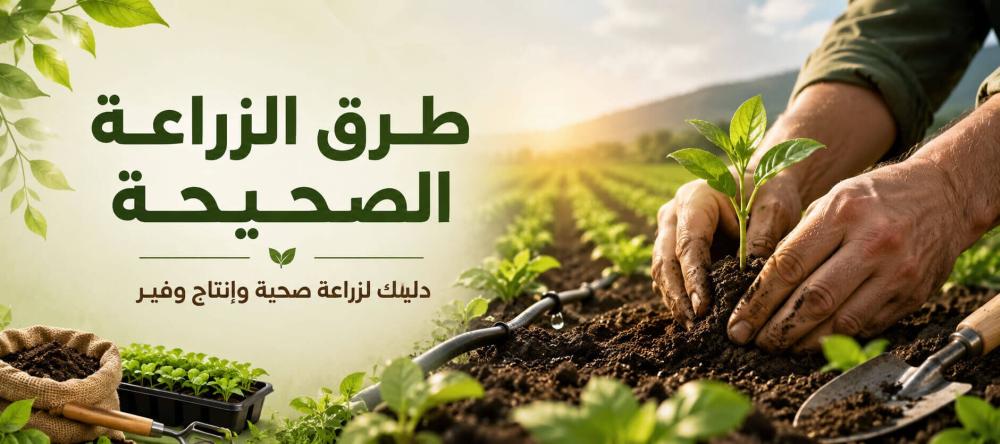
The journey of farming begins with a tiny seed and ends with a bountiful harvest, holding within it the secrets of nature and the wonders of creation. Whether you're a beginner taking your first steps into the world of agriculture, or a seasoned farmer striving to increase the productivity and quality of your crops, mastering proper farming methods is the golden key to achieving success and sustainability. In this comprehensive article, we'll guide you through well-thought-out, detailed steps to understand all aspects of successful farming. We'll cover everything from soil preparation to pest control, highlighting the products offered by Al-Talib Store, your trusted partner on your farming journey.
What are correct farming methods?
Proper agricultural practices are a set of scientific and practical procedures aimed at creating the best possible conditions for plant growth, development, and production. It is an integrated system that includes selecting a suitable location, preparing and improving the soil, choosing high-quality seeds or seedlings, determining optimal planting dates, and providing the plant's basic needs for water, nutrients, and light, while anticipating potential risks from pests and diseases.
Benefits of following correct farming methods
Adopting proper farming methods brings numerous benefits that are not limited to obtaining a bountiful harvest, but extend to include economic, health and environmental aspects:
- Plants that grow under optimal conditions are healthier and stronger, which is reflected in the quantity and quality of their fruit or crop. You will get larger, tastier, and more nutritious fruits and vegetables.
- Applying proper farming methods ensures the efficient use of water, fertilizers, and pesticides, reducing waste and lowering costs. For example, proper irrigation saves significant amounts of water, and balanced fertilization prevents fertilizer waste.
- Strong, healthy plants are more resistant to stress, diseases, and pests. Proper agricultural practices, such as maintaining adequate spacing, also reduce excess moisture around plants, thus limiting the spread of fungal diseases.
- Proper farming, especially when using organic fertilizers and natural pesticides, maintains soil fertility in the long term and reduces environmental pollution caused by the surface runoff of chemicals.
- When your efforts pay off and you see your plants grow, bloom, and bear fruit, you'll experience an immense sense of accomplishment and satisfaction. Successful gardening reduces the frustration of plant death or poor growth, making the entire experience more enjoyable and sustainable.
What are the correct farming methods?
Here are the correct farming methods, from soil preparation to harvesting:
Preparing the land and soil before planting
- Soil is the foundation of any successful agricultural project; it is the vessel that houses the roots and provides the plant with nutrients and water. Therefore, it requires special attention.
- Begin by removing all stones, root debris, and weeds from the planting area. These weeds compete with the plants for water, nutrients, and light, and may harbor pests and diseases.
- Plowing, turning, and loosening the soil with a plow increases soil aeration, improves its water retention capacity, and facilitates root penetration and spread.
- Heavy clay soils or light sandy soils are not ideal for agriculture. The best solution is to improve them by adding organic matter. A balanced mixture of clay and sandy soils with generous amounts of well-rotted compost is preferred to improve the soil's physical and chemical properties.
Adding organic fertilizer and its decomposition in the soil
- Fertilization is essential to replenish the nutrients depleted from the soil with each growing season. Organic fertilizer is your best option for building healthy and sustainable soil.
- Organic fertilizer provides the soil with the major (nitrogen, phosphorus, potassium) and minor elements necessary for growth, improves the soil's ability to retain water and aeration, and nourishes the beneficial microorganisms in the soil that play a vital role in breaking down organic matter and making food available to the plant.
- It is preferable to add organic fertilizer to the soil at least two weeks before planting to allow it to partially decompose and mix well. Additional amounts can be added around the plants during the growing season to support them during critical growth stages such as flowering and fruit set.
How to choose the right container or space for planting
- Home gardening often relies on containers, while outdoor spaces require different planning.
- When planting in a pot, ensure it is the appropriate size for the plant type. The pot should be deep enough (at least 6-8 cm for seeds) to allow the roots to spread comfortably. The most important requirement is drainage holes at the bottom to prevent waterlogging, which can lead to root rot. You can start with small pots for germination and then transplant the seedlings into larger ones.
- In field farming, ensure that the allocated space is sufficient for the plants to reach their final growth stage and that they do not compete for resources. Overcrowding leads to stunted growth and increased susceptibility to disease.
How to choose the right seeds or seedlings
- Choosing the right seeds is the foundation of agriculture; you cannot succeed by planting damaged seeds or seeds that are unsuitable for your region.
- Choose healthy seeds that are free from deformities or mold and of a reliable source. It is preferable to purchase seeds from trusted companies or specialized stores such as Al-Talib Store to ensure a high germination rate and good purity. Always check the expiration date of the seeds.
- Make sure the variety you choose is suitable for the local climate (hot, temperate, or cold) and the growing season (summer or winter). Some varieties tolerate drought and heat, while others need a more temperate environment.
- The method of sowing seeds in soil is important because some seeds with hard shells, such as beans and chickpeas, have difficulty germinating. You can help them by subjecting them to a thermal shock, such as soaking them in warm water for 24 hours, or by gently breaking off a small part of the outer shell before planting.
How to determine the appropriate distances between plants
- This is one of the most important secrets to proper farming methods. Inappropriate spacing is a major cause of poor crop yields.
- Closely planted plants create intense competition for water, food, and light, and reduce air circulation around the plants, increasing humidity and encouraging the growth of fungal diseases.
- The required spacing varies depending on the type and size of the plant at maturity. A common rule is to cover the seeds with soil two to three times the thickness of the seed itself. As for the spacing between plants, it should be sufficient to allow each plant to grow fully without crowding.
Consult the instructions on the seed packet or ask the experts at Al Talib Store for accurate recommendations for each crop.
Determining the correct planting dates
- Timing is everything in agriculture. Planting a crop out of season means certain failure.
- Planting seasons: Crops are generally divided into summer crops (planted in spring and growing in the heat) and winter crops (planted in autumn and growing in the cold). Selecting the correct season ensures that the plant will find the appropriate climatic conditions for its growth, flowering, and fruiting.
- Don't rely solely on the calendar; monitor the actual weather. Ensure the soil is warm enough (around 24°C for most seeds) before planting, especially in early spring, to avoid late frosts that could kill seedlings.
Proper irrigation methods for plants
- Water is a vital element, but too much of it can be as deadly as thirst.
- The goal is to maintain consistent soil moisture, not overwater. A common mistake is watering lightly every day, which encourages the growth of weak, shallow roots. A better approach is to water deeply and at longer intervals to encourage the roots to grow deeper in search of water, making the plant stronger and more drought-tolerant.
You may be interested in: How to make a sprinkler irrigation system
Fertilization and soil nutrition
- As the plant grows and consumes nutrients, the soil needs to be replenished to ensure continued strong growth and production.
- In addition to basic organic fertilizer, plants may require additional applications of chemical and organic fertilizers during their various growth stages. Specialized fertilizers rich in nitrogen are available for vegetative growth, while others rich in phosphorus and potassium support flowering and fruiting.
- Follow the planting steps illustrated in the instructions on the fertilizer container to determine the appropriate dosage. Over-fertilizing, especially with chemical fertilizers, can burn the roots and cause more harm than good. Drip fertilization or foliar fertilization are effective methods for delivering nutrients to plants.
Lighting and its role in agricultural success
- Light is the source of energy that drives photosynthesis, the process by which a plant makes its own food.
- Plants have different light needs. Some need direct light for several hours (at least 6-8 hours), while others prefer indirect light or partial shade.
- The distance between the light source and the plant should be appropriate (more than 30 cm for LED lamps, and 8-12 cm for fluorescent) to avoid burning the leaves.
- Rotate the pots periodically to ensure that all sides of the plant receive even light and to prevent uneven growth towards the light source.
Controlling pests and diseases using natural methods
- Following proper farming methods greatly reduces pest and disease problems.
- Choose resistant varieties, follow appropriate planting dates, maintain good spacing between plants for ventilation, use clean and sterilized soil, and do not overwater.
- Natural control: If pests appear, try natural solutions first. You can plant insect-repellent plants alongside susceptible crops, use safe biopesticides, or spray a mixture of water and alkaline soap on soft-bodied insects. Use chemical pesticides only as a last resort, and then strictly adhere to the recommended dosages and safety instructions.
Transplanting and care of seedlings after growth
- When the seeds have grown into strong seedlings, it's time to transplant them to their permanent location. This stage is critical and requires careful attention.
- Before transplanting seedlings outdoors, they should be gradually exposed to the elements (sunlight, wind, and temperature fluctuations) for about a week. This process, called hardening off, prevents the seedlings from experiencing shock that could weaken or kill them. Start by placing them in a shady spot for several hours each day, then gradually increase the time and expose them to direct sunlight.
- Gently transplant the seedlings into the ground or their permanent pot on a cloudy day or in the evening to minimize heat stress. Plant them at the same depth they were in their seedling trays, gently firm the soil around the roots, and water them thoroughly after transplanting.
Common mistakes to avoid in agriculture
To ensure the success of your farming, avoid these common mistakes that many people make:
- Overwatering is the leading cause of houseplant death. It leads to root rot and fungal growth. Check the soil is dry before watering again.
- Sowing too deep: Burying seeds too deeply prevents germination or weakens seedlings. The rule of thumb: The planting depth should be 2-3 times the size of the seed.
- Neglecting soil aeration: Soil compaction leads to root suffocation. Loosen the surface soil occasionally without damaging the roots.
- Insufficient lighting: Plants that do not receive enough light become weak, elongated, and droopy (elongation phenomenon).
- Over-fertilizing: Root burns from excessive chemical fertilizers can be fatal. Always follow the recommended dosages.
You may be interested in: Agricultural soil problems and their solutions
Al Talib Store for learning about correct farming methods
Al Talib Store is your ideal partner, as it is one of the oldest and largest leading companies in the Kingdom of Saudi Arabia in the field of providing agricultural supplies, offering you:
- The store offers a wide range of products that cover all your agricultural needs, from high-germination improved seeds, organic and specialized fertilizers from Al-Wissam Factory, to irrigation and pest control tools and supplies, and even shade netting and agricultural equipment.
- Thanks to its strong international partnerships with major companies in America, Europe, and Asia, Al Taleb Store is committed to providing innovative agricultural solutions and global quality standards.
Whether you are looking for high-quality soil to start your farming, guaranteed vegetable seeds, or specialized fertilizers, Al Taleb Store is your first destination to ensure you get the right supplies for successful farming.
Conclusion
Proper farming methods are a philosophy based on a deep understanding of plant needs and respect for nature. By applying the principles we've outlined in this article, from soil preparation to selecting suitable seeds, and from regulating irrigation to lighting and fertilization, you can transform your green space into a fruitful oasis that brings you both bounty and beauty.
Remember that farming is a continuous journey of learning and experimentation. Draw on knowledge, consult experts, and carefully select your supplies from reliable sources like Al Talib Store to ensure that every step you take is a step towards success.
Frequently asked questions about proper farming methods
1. What is the ideal time for watering in the summer?
The ideal time is early morning before sunrise or in the evening after sunset. This reduces water loss due to excessive evaporation and allows the plant to absorb water before the heat reaches its peak.
2. How do I know if the seeds I bought are good?
You can perform a simple germination test: place a number of seeds between two layers of damp tissue paper and keep them in a warm place. If a high percentage (more than 80%) germinate within the expected time, they are good seeds. It is always best to buy seeds from reputable sources such as Al-Talib Store to ensure their quality.
3. Which plants are easiest for beginners?
Plants such as basil, mint, cherry tomatoes, lettuce, and radishes are excellent choices for beginners because they grow quickly and do not require excessive care.